

Where Can You Get Abscess Incision and Drainage in McDonough, GA
Skin abscesses are intensely painful, inflamed lumps triggered by bacterial infections. Because they rarely heal efficiently on their own, the professionals at MedLife Primary & Urgent Care provide comprehensive evaluations and perform sterile incision and drainage when medically indicated. Addressing an abscess quickly is crucial to relieving built-up discomfort, clearing out the pus, and stopping the infection in its tracks. For more information, contact us or request an appointment online. We are conveniently located at 325 Huntington Pl Ct, McDonough, GA 30253.
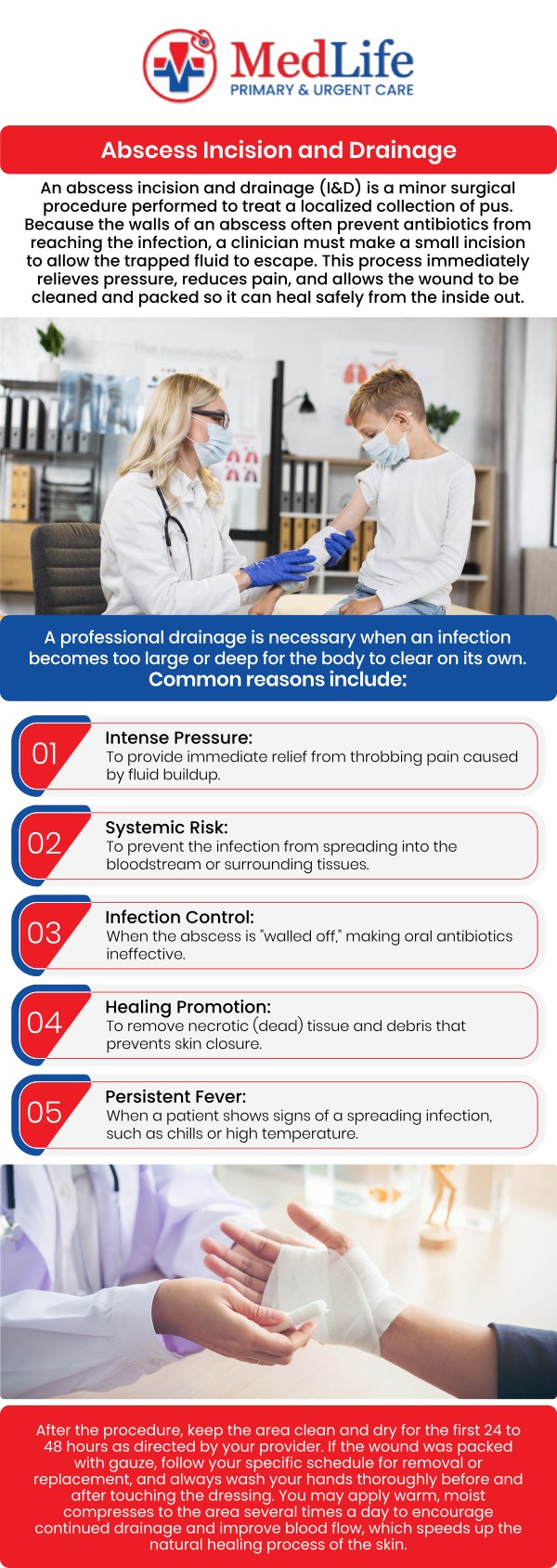
Table of Contents:
What is abscess incision and drainage, and how does it work?
When is abscess incision and drainage recommended?
What should you expect during an abscess incision and drainage procedure?
How long does healing take after abscess incision and drainage?
Personalized Care for Skin Abscesses at MedLife Primary & Urgent Care in McDonough, GA
Abscess incision and drainage, often called I&D, releases pus from a pocket of infection. A skin abscess commonly feels warm and tender and may have a soft center. Draining it helps relieve pressure and removes infected material so the area can heal.
Your MedLife clinician will examine the area to determine the abscess’s size, location, and severity. If it appears deep or involves sensitive structures, we may need additional imaging or a referral.
If an in-office drainage procedure is appropriate, your clinician will typically:
• Clean and numb the area: A local anesthetic helps reduce pain, although you may still feel pressure or discomfort.
• Drain the infection: A small incision allows pus to drain. The clinician may gently open internal pockets to help remove remaining infected material.
• Collect a sample when needed: Pus may be sent to a laboratory, particularly if the infection is recurrent or severe.
• Dress the wound: The opening is generally left unstitched to allow continued drainage and healing from the inside outward.
Some abscesses require a small drain or gauze packing, but packing is not routinely needed for many small, uncomplicated skin abscesses.
Pain and pressure often improve soon after drainage, though tenderness and drainage may continue for several days. Healing can take a few days to several weeks, depending on the abscess’s size and depth and your overall health.
When should you seek medical care?
Do not squeeze, puncture, or cut open an abscess yourself. This can spread infection or damage nearby tissue.
Seek prompt medical evaluation if you have:
• Fever, spreading redness, red streaks, or worsening pain.
• An abscess near the eye, on the face, or around the anus or genitals.
• Diabetes or a weakened immune system.
• An abscess that keeps returning or is not improving.
A painful, swollen lump may be a skin abscess—a pocket of pus caused by infection. At MedLife Primary and Urgent Care, a healthcare provider can evaluate the area and recommend appropriate treatment, which may include incision and drainage or referral for specialized care.
Incision and drainage is often recommended when an abscess has formed and is unlikely to resolve on its own. Signs that drainage may be needed include:
• A painful, swollen lump with a soft or fluid-filled center
• Visible pus or drainage
• Increasing tenderness or swelling
• An abscess that is growing or not improving with initial care
There is no single size cutoff for drainage. Your provider will consider the abscess’s depth, location, and severity, along with your overall health. If it is unclear whether pus has collected beneath the skin, ultrasound may be needed. Some very small, superficial abscesses may improve with warm compresses and close monitoring.
Seek prompt medical assessment for an abscess near the eye or nose, on the hand, or near a joint. These areas may require specialist care. Deep or internal abscesses may need imaging-guided drainage or surgery rather than a simple skin incision.
Fever, rapidly spreading redness, or worsening pain require urgent evaluation. Seek emergency care for confusion, severe or rapidly worsening pain, or feeling seriously unwell.
Do not squeeze, puncture, or cut an abscess yourself. Contact MedLife Primary and Urgent Care for an evaluation to determine whether drainage is appropriate and what treatment or referral you may need.
A painful, swollen bump beneath the skin may be an abscess—a pocket of pus caused by an infection. At MedLife Primary and Urgent Care, a clinician can evaluate the area and recommend appropriate treatment, which may include incision and drainage or referral for more specialized care.
Incision and drainage releases trapped pus and is often the main treatment for a skin abscess. Antibiotics alone may not adequately treat the infection. Most uncomplicated abscesses can be treated in an outpatient setting, allowing you to go home afterward.
Before the procedure
Your clinician will examine the affected area to assess the abscess’s size, depth, and location. Abscesses that are large, deep, or near sensitive structures may require specialist treatment.
Tell your clinician about any medication allergies, blood-thinning medicines, diabetes, immune system conditions, or possibility of pregnancy.
If drainage is appropriate, the skin will be cleaned, and a local anesthetic will usually be injected around the abscess. Let your clinician know if you do so they can adjust your pain control. More complex cases may require treatment in a setting equipped for sedation or surgery.
During drainage
The clinician makes a small opening in the abscess to allow the pus to drain. They may gently explore the cavity to release separate pockets of pus and rinse the area. A sample may be collected for testing, particularly if the infection is recurrent, severe, or not responding to treatment.
The opening is usually left unstitched so fluid can continue to drain as the wound heals. Depending on the abscess, a small drain or gauze packing may be placed inside. Packing is not necessary for every abscess, especially smaller, uncomplicated ones. A dressing is then applied to protect the wound.
The drainage itself often takes only a few minutes, although preparation and more complex treatment can take longer.
After the procedure
Releasing the pressure often helps relieve pain, though soreness and some blood-tinged drainage are common afterward. Your treating clinician will provide instructions on:
• Cleaning the wound and changing dressings
• Bathing and caring for the area
• Managing discomfort
• Taking antibiotics, if prescribed
• Returning for a wound check or packing or drain removal, if needed
When should you seek additional care?
Seek prompt medical care if you develop fever, spreading redness, worsening swelling or pain, or drainage that increases rather than improves. Uncontrolled bleeding or feeling seriously unwell requires urgent assessment.
Most small skin abscesses heal within 1–2 weeks after incision and drainage. Larger or deeper abscesses may take 2–4 weeks or longer to close completely. At MedLife Primary and Urgent Care, your clinician can assess your wound and discuss what to expect based on the abscess’s size, location, and your overall health. Diabetes, smoking, a weakened immune system, or an ongoing infection can slow healing.
Caring for your wound
Follow the wound-care instructions provided by your treating clinician, including how to clean the area and change dressings. If packing was placed, follow the specific plan for removal or replacement; a wound check is often needed within 24–48 hours. Avoid squeezing or probing the area. If antibiotics were prescribed, take them as directed—they are not necessary for every drained abscess.
When to seek follow-up care
Contact MedLife Primary and Urgent Care or your treating clinician promptly if pain, redness, or swelling worsens, drainage increases or becomes foul-smelling, or you develop fever, chills, or red streaks spreading from the wound.
Arrange reassessment if there is no clear improvement within 48 hours or the wound is not healing as expected. Abscesses near the anus or genitals, as well as those that repeatedly return, may need additional evaluation.
When you visit MedLife Primary & Urgent Care with a painful, swollen, or red skin abscess, our experienced medical staff delivers care tailored specifically to your needs. Our team thoroughly evaluate the abscess’s location, size, and severity to decide if an incision and drainage procedure is the best course of action. If indicated, our providers will make a precise, sterile incision to safely drain the trapped pus, immediately relieving physical pressure and jumpstarting the healing process.
Beyond the procedure itself, our team equip you with customized aftercare instructions. Our team will guide you on how to clean the wound, manage the infection at home, and monitor your recovery. For more information, contact us or request an appointment online. We are conveniently located at 325 Huntington Pl Ct, McDonough, GA 30253. We serve patients from McDonough GA, Stockbridge GA, Lovejoy GA, Hampton GA, Morrow GA, and surrounding areas.
Check Out Our 5 Star Reviews


Additional Services You May Need
• Urgent Care
• Abscess Incision/Drainage
• Aches and Pain
• Acute Care
• ADHD
• Allergic Reactions
• Allergies
• Allergy Testing
• Animal Bites
• Annual Physicals
• Anxiety
• Asthma
• Athlete’s Foot/Fungus
• Atopic Dermatitis
• Autonomic Nervous System Scans
• Blood Glucose
• Blood Pressure Screening
• Bronchitis
• Chronic Atrial Fibrillation
• Ultrasounds
• Urinalysis
• Weight Loss
• Wound Infection
• Chronic Care
• Chronic Pain
• Cold Symptoms
• Congestion
• Congestive Heart Failure (CHF) Care
• COPD
• Cough
• COVID Testing
• Dehydration
• Dementia
• Depression
• Diabetes
• Diabetic Neuropathy Screening
• Diabetic Retinal/Eye Exams
• Diarrhea
• DOT Physical Exams
• Ear Infection
• Earache
• Echocardiograms
• Urine Drug Testing
• Vaccinations
• X-Rays
• Electrocardiogram (EKG)
• Employment Physical Exams (Non-FAA)
• Epilepsy
• Eye Problems
• Fever
• Fibromyalgia
• Flu
• Foreign Body Removal
• Fractures
• Gastrointestinal Disorders
• GERD
• Gout Treatment
• Gynecological Care for Women
• Headaches
• Hearing/Vision Test
• Hyperlipidemia
• Hypertension
• Immigration Physical
• Insect Bites
• Irritable Bowel Syndrome (IBS)
• Laceration Repair & Stitches
• Primary Care
• Myers’ IV infusion
• Lead Screening
• Lupus
• Migraines
• Neuro Scan
• Occult Blood
• Osteoarthritis
• Osteoporosis
• PAP Smears
• Pre-Op Clearance Exam
• Pregnancy Testing
• Rheumatoid Arthritis
• School Physicals
• Spirometry
• Splinter Removal
• Sports Physicals
• Sprains
• STD Screening
• Strep Throat
• TB Screening
• Thyroid Disorder
• Allergy Immunotherapy

Additional Services You May Need
• Urgent Care
• Abscess Incision/Drainage
• Aches and Pain
• Acute Care
• ADHD
• Allergic Reactions
• Allergies
• Allergy Testing
• Animal Bites
• Annual Physicals
• Anxiety
• Asthma
• Athlete’s Foot/Fungus
• Atopic Dermatitis
• Autonomic Nervous System Scans
• Blood Glucose
• Blood Pressure Screening
• Bronchitis
• Chronic Atrial Fibrillation
• Ultrasounds
• Urinalysis
• Chronic Care
• Chronic Pain
• Cold Symptoms
• Congestion
• Congestive Heart Failure (CHF) Care
• COPD
• Cough
• COVID Testing
• Dehydration
• Dementia
• Depression
• Diabetes
• Diabetic Neuropathy Screening
• Diabetic Retinal/Eye Exams
• Diarrhea
• DOT Physical Exams
• Ear Infection
• Earache
• Echocardiograms
• Urine Drug Testing
• Vaccinations
• Electrocardiogram (EKG)
• Employment Physical Exams (Non-FAA)
• Epilepsy
• Eye Problems
• Fever
• Fibromyalgia
• Flu
• Foreign Body Removal
• Fractures
• Gastrointestinal Disorders
• GERD
• Gout Treatment
• Gynecological Care for Women
• Headaches
• Hearing/Vision Test
• Hyperlipidemia
• Hypertension
• Immigration Physical
• Insect Bites
• Irritable Bowel Syndrome (IBS)
• Laceration Repair & Stitches
• Weight Loss
• Wound Infection
• Lead Screening
• Lupus
• Migraines
• Neuro Scan
• Occult Blood
• Osteoarthritis
• Osteoporosis
• PAP Smears
• Pre-Op Clearance Exam
• Pregnancy Testing
• Rheumatoid Arthritis
• School Physicals
• Spirometry
• Splinter Removal
• Sports Physicals
• Sprains
• STD Screening
• Strep Throat
• TB Screening
• Thyroid Disorder
• X-Rays
• Allergy Immunotherapy


 Send Text
 How May I Help You?
